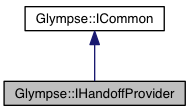
The interface to abstract the details of implementation of specific handoff provider. More...
#include <IHandoffProvider.h>
Public Member Functions | |
| virtual bool | isEnabled ()=0 |
| Indicates whether provider session is currently enabled. More... | |
| virtual GString | getProviderId ()=0 |
| Gets unique provider identifier. More... | |
| virtual bool | isHandoffAvailable ()=0 |
| Tells host application if platform is fully functional and can handoff active tickets by means of the provider. More... | |
| virtual bool | isForceable ()=0 |
| Indicates whether this provider is allowed to be directly set as the active handoff provider. More... | |
| virtual GString | getActionUri (int32 action)=0 |
| Generates action URI for external operations supported by the provider. More... | |
| virtual int32 | getDisabledTicketFields ()=0 |
| Provides bitmask of fields that should not be disabled in the UI while provider is active. More... | |
| virtual void | allowHandoff ()=0 |
| Ticket handoff procedure is aimed to enhance user experience. More... | |
| virtual bool | isHandoffAllowed ()=0 |
| Checks to see if user has already allowed ticket handoff in this session. More... | |
 Public Member Functions inherited from Glympse::ICommon Public Member Functions inherited from Glympse::ICommon | |
| virtual int32 | retain ()=0 |
| Add a reference to our object in a COM-like way. | |
| virtual int32 | release ()=0 |
| Release a reference to our object in a COM-like way. | |
| virtual int32 | hold ()=0 |
| Add a reference to our object in a COM-like way. | |
| virtual int32 | unhold ()=0 |
| Release a reference to our object in a COM-like way. | |
| virtual int32 | hashCode ()=0 |
| Returns an integer hash code for this object. | |
| virtual bool | equals (const GCommonObj &o)=0 |
| Compares this instance with the specified object and indicates if they are equal. More... | |
| virtual GString | toString ()=0 |
| Returns a string containing a concise, human-readable description of this object. More... | |
| virtual void | attachObject (const GCommon &obj)=0 |
| Asociates arbitrary object with the instance. | |
| virtual GCommon | extractObject ()=0 |
| Extracts associated object or NULL if no association is established. | |
Additional Inherited Members | |
| Protected Member Functions inherited from Glympse::ICommon | |
| virtual | ~ICommon () |
| Destructor is protected to deny explicit object deallocation. More... | |
The interface to abstract the details of implementation of specific handoff provider.
|
pure virtual |
Ticket handoff procedure is aimed to enhance user experience.
However some accompanying actions performed by the platform go in contrast with its regular behavior. Therefore user confirmation is required in order for this techniqueue to be enabled.
The method needs to be invoked upon receiving confirmation from a user.
Platform does not persist user preference, but it is kept in memory for the entire duration of application session. Host application is free to persist user choice and apply it every time when provider is activated.
Handoff is not allowed by default.
|
pure virtual |
Generates action URI for external operations supported by the provider.
Action URI is supposed to be invoked in platform specific way to be picked up by corresponding application (in most cases - default browser) based on URI schema.
The most commonly used action is GC::HANDOFF_ACTION_SEND.
|
pure virtual |
Provides bitmask of fields that should not be disabled in the UI while provider is active.
The limitation is usually caused by the fact that corresponding tracking agent will override those fields anyway after successful handoff.
|
pure virtual |
Gets unique provider identifier.
Currently supported providers:
|
pure virtual |
Indicates whether provider session is currently enabled.
|
pure virtual |
Indicates whether this provider is allowed to be directly set as the active handoff provider.
|
pure virtual |
Checks to see if user has already allowed ticket handoff in this session.
|
pure virtual |
Tells host application if platform is fully functional and can handoff active tickets by means of the provider.
This property can be used by host applications to choose the course of action, when provider is activated. Some providers allow alternative mechanisms for sending tickets when device is not connected to the internet.
 1.8.4
1.8.4

