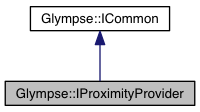
The IProximityProvider provides standard interface for geo-fencing. More...
#include <IProximityProvider.h>
Public Member Functions | |
| virtual void | setProximityListener (const GProximityListener &proximityListener)=0 |
| Attaches proximity listener to the provider. | |
| virtual void | startMonitoring (const GRegion ®ion)=0 |
| Starts monitoring the region. More... | |
| virtual void | startMonitoring (const GArray< GRegion >::ptr ®ions)=0 |
| Starts monitoring the list of regions. | |
| virtual void | stopMonitoring (const GRegion ®ion)=0 |
| Stops monitoring the region. | |
| virtual void | locationChanged (const GLocation &location)=0 |
| This method is called, when location manager is notified on new location point by location provider. More... | |
| virtual GArray< GRegion >::ptr | detachRegions ()=0 |
| Stops monitoring all regions and returns the list. More... | |
 Public Member Functions inherited from Glympse::ICommon Public Member Functions inherited from Glympse::ICommon | |
| virtual int32 | retain ()=0 |
| Add a reference to our object in a COM-like way. | |
| virtual int32 | release ()=0 |
| Release a reference to our object in a COM-like way. | |
| virtual int32 | hold ()=0 |
| Add a reference to our object in a COM-like way. | |
| virtual int32 | unhold ()=0 |
| Release a reference to our object in a COM-like way. | |
| virtual int32 | hashCode ()=0 |
| Returns an integer hash code for this object. | |
| virtual bool | equals (const GCommonObj &o)=0 |
| Compares this instance with the specified object and indicates if they are equal. More... | |
| virtual GString | toString ()=0 |
| Returns a string containing a concise, human-readable description of this object. More... | |
| virtual void | attachObject (const GCommon &obj)=0 |
| Asociates arbitrary object with the instance. | |
| virtual GCommon | extractObject ()=0 |
| Extracts associated object or NULL if no association is established. | |
Additional Inherited Members | |
| Protected Member Functions inherited from Glympse::ICommon | |
| virtual | ~ICommon () |
| Destructor is protected to deny explicit object deallocation. More... | |
The IProximityProvider provides standard interface for geo-fencing.
The following scenarios are supported:
Proximity provider never stops monitoring regions automatically after delivering notification. Host application is always responsible for registering and unregistering geofences.
Here is how to set external provider. It is only allowed to call IGlympse::getLocationManager() method after starting the platform (by calling IGlympse::start()).
Stops monitoring all regions and returns the list.
|
pure virtual |
This method is called, when location manager is notified on new location point by location provider.
| location | New location object. |
|
pure virtual |
Starts monitoring the region.
| region | Region object to start monitoring. |
 1.8.4
1.8.4

